Showing posts with label G321 Preliminary task. Show all posts

Wednesday, 28 November 2012

My Final Preliminary Task Mark

Here is my grade for my preliminary task where I received a C. I received many good areas to the task although bordering the weak areas.
Teacher Feedback:
'Strong start wth over the shoulder shot.
At 0.41 - 0.43 a very compelent high angle/birds eye shot which added to variety.
Transition as character walks into editing room ( cut between opening door and entering room) is rather Jerky.
All three principles covered well (shot reverse shots - very good; 180 degree rule applied; match on action - generally good.
Sound

Monday, 12 November 2012

Development of Evalution

I have decided to take my tutor advice and have opted to talk about which angles worked in our preliminary task and which didn't. Firstly I think that one shot that worked well was our first shot. This was the Over The Shoulder shot which I feel was successful because it helps to place the audience in the position of the character. It also symbolises somebody following the character as well.
It also was a tracking shot which followed the character as they walked towards their target while the Over The Shoulder shot was taking place.

Another shot that I think was used well in our preliminary task was not breaking the 180 degree rule while we filmed it. Here we can establish that during the conversation we have the camera facing the two main characters. We can see that we haven't broken the 180 degree rule and this was because we had a wall behind us and we were not able to do it. We haven't disorientated the audience as they are able to establish where the characters are and have been, and we know they haven't moved.

Lastly, our conversation was school themed. It consisted of one character talking to the other about the media lesson. This was about the media lesson being cancelled and having to catch up on work, where one character was worried that she couldn't whereas the other not minding and thinking a lesson off was goodand she'd be able to catch up easily.

Tuesday, 23 October 2012

Evaluation continued- Examples

Examples of 180 degree rule, Shot reverse shot and Match on action.

Shot Reverse Shot
This is an example of the shot reverse shot which is a technique where one character is shown looking towards another character and then the other character is shown looking back at the first character. The viewer would now assume that they are looking at each other.


180 Degree Rule
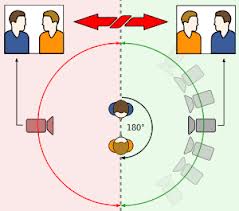
 This is an example of the 180 degree rule showing two characters in the same scene which should always have the same left/right relationship to each other. If the camera passes over the imaginary axis connecting the two subjects it will confuse the viewing audience.


Match on Action
This is an example of the match on action shot. This is a shot which cuts from one shot to another that matches the action and pace of the first shot to create an impression of continuity. This also creates a visual bridge which can disguise the cut from one to the other

Thursday, 11 October 2012

Evaluation

1 - For my preliminary task, I used a planning sheet specifiying what everyone in our group was doing in our short film. It consists of the different types of shots that would be considered when we were shooting our film. For example, the tracking shot was used for walking around a corner and following that person around. I also used the order in which the shots would take place. Lastly I also used a storyboard which helped to show where the scene were to take place and what shots would be present at that specific moment in time.

Planning this way was useful because then I was able to know what was supposed to be happening at each moment during this short film. However, our actual film differed very slightly to my plans due to the fact that we included an extra shot showing the main character moving towards the camera which wasn't included on my plans.

 2 - During this process of making this short film, I believe that I have developed my skills in all of the camera shots I used and also practised. However one shot I think that I have developed and perfected the use of the close up shot due to the reason that I think the shots i performed using the close up shot were wonderfull. Secondly, I feel that I know the cameras well and how to use them; at the beginning of the project I was unsure but as it has progressed I've become more associated with them. With the cameras I had to zoom in and out which has improved the usage of the camera to give the films better effect in a sense. Throughout are short film I was able to use camera angles more effectively which in turn makes for a better film. For example, I used the close up shot on a few occasions which gave utilised to closely identify the action being partaken.

3 - Throughout this process of making the film we had to edit it as well. I believe that I had developed many editing skills in this time. One being having to include all the transititons onto the film in order to make it look extravagant and professional, however making it look realistic at the same time. I feel now that I have developed this skills effectively so I think I can do it better now. Secondly, using this editing program at first I was a little confused on what to do and how to edit it, however as it has gone on I feel I have gotten more confident with the software, despite the fact I am still blind t some of the software on it.
One certain area that I feel I have improved and developed the most is that of 'input' and 'output'. These ensure that the certain pieces of the scenes can be edited to make sure you have the bits you need and the other pieces can be discarded.
I think there are still areas that I need to improve on; the first one is to make use of the transtitions more effectively and to use them more. This would ensure my films don't have any 'laggy' bits and so it keeps my film and the transititons between each of the different scenes even smooth.

I feel that working in my group had many benefits; despite the fact some of us didn't know each other throughout but we do now. The group worked very well together and we had a laugh while making it as well. Lastly, our film turned out very successfully and the reason behind this was we ad fun while making it, which in turn resulted in our film being a successful piece.
 It was also successful through the 180 degree rule not being broken thoughout the entire short film which in turn kept the audience orientated and left them knowing where and what the characters were doing.

Wednesday, 3 October 2012

Shot List

Over the Shoulder shot while tracking is taking place
Close up of the hand opening the door
Tracking shot walking out door and around corner
Longshot of the walk down the corridor
Birds eye view of the walk down the corridor
Over the shoulder and close up of opening door
Shot reverse shot of the conversation

Tuesday, 2 October 2012

Rest of the camera shots -birds eye; worms eye and rule of thirds


This is my worms eye view of a motor bike. This is a object view from below as though the observer was from a worm.  A worms eye view is used commonly for third persepective which is also usful when making movies.


This is a rule of thirds shot that i took from my holiday in turkey. This is a shot of the boat on the left, the water in the background and the chairs on the right. The image shows that the picture should be divided into 9 sections. It also shows 3 important elements in the picture.


 This is a birds eye view of my back garden when it was being refurbished with concrete. I took it from my back room window. This view is elevated from something from the floor and gives the perspective of a bird up high.

Wednesday, 26 September 2012

My Storyboard - Re-done

These two storyboards are what me and my group will be constructing during our G321 preliminary task. It tells everybody what the camarea shots will be for the certain scene and what will be happening during these scenes. It also gives everybody a rough idea of where the route of the walk to the conversation will actually take place.


Planning - G321

My planning for my preliminary task G321. It consists of camera angles we will use and what each of the four people in our group will do for the shoot.

Monday, 17 September 2012

Examples of camara shots - Homework- Mrs Barton

This is an over the shoulder shot which is used to portray someone following someone else or to put the audience into the characters shoes.
This image is an extreme close up which is used to utilise the character or action closely.
This is a close up shot with a slight question of medium close up also which is used to help allow the audience to identify the characters emotions.
This image is known as the low angle shot. This type of image helps create a sense or power to the actor. It also shows a sense of power and control towards the character which also gives them status.
This image is known as the longshot. This image is used simply to help etsablish the location or the actor.
This is the high angle shot. This shot helps to create the idea of insignificance and vulnerability towards the audience. However this shot also positions the audience.
This image is known as the tilt. It is used in my circumstances to create confusion or disorientation towards the viewing audience. Sometimes it is also used to show a sense of nightmare.